









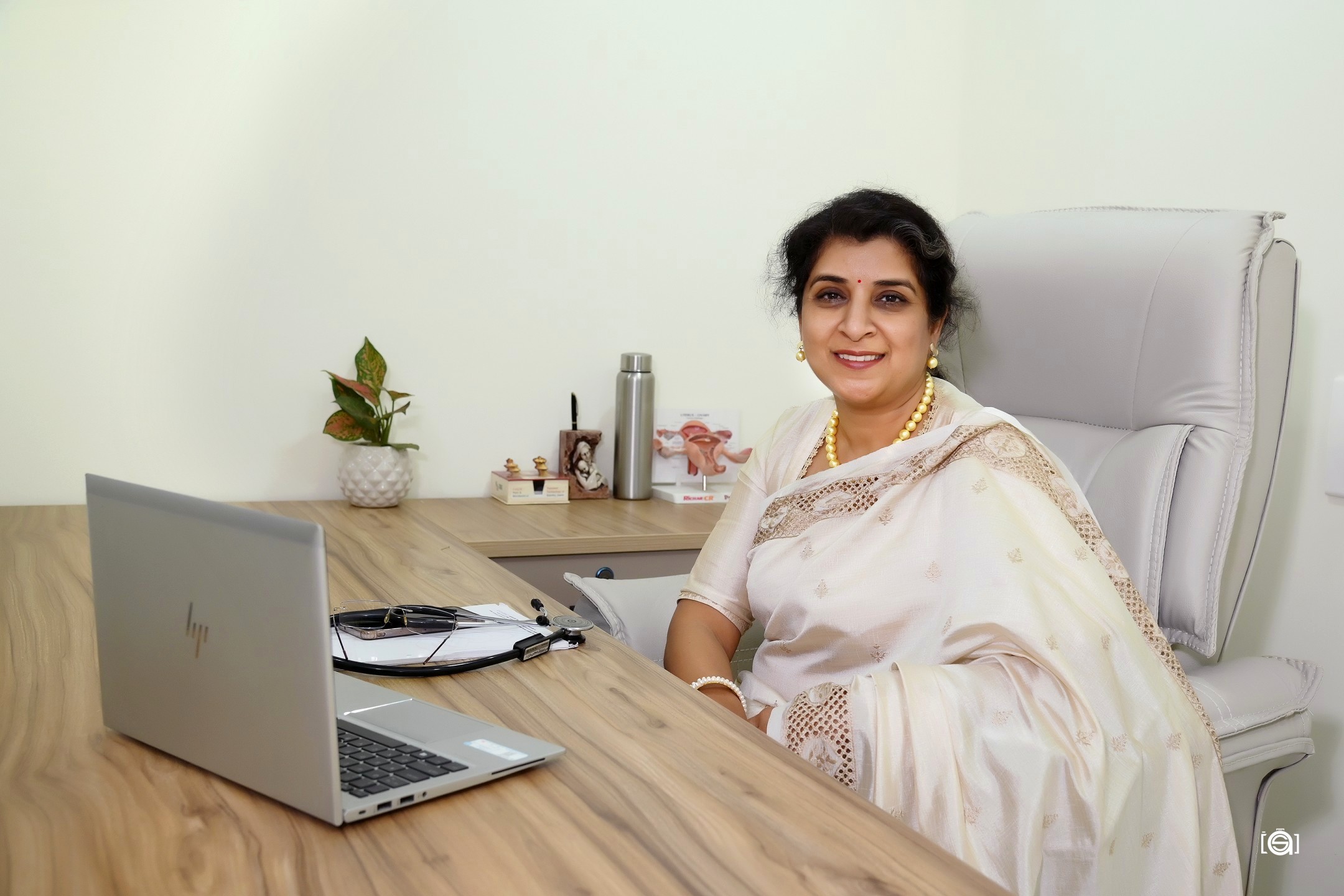
By Dr. Shweta Agarwal, MBBS, DGO Medically reviewed by Dr. Shweta Agarwal, MBBS, DGO Last updated: June 2026
Information on this page is educational and does not replace a medical consultation. Outcomes depend on individual clinical factors.
Aansh Hospital & IVF Center is a government-registered Level-2 ART clinic (Reg. No. MH/AC/2024/15441/L2/Chandrapur/132), part of a growing chain of fertility centers across Vidarbha and northern Telangana, with our headquarters and in-house embryology lab in Chandrapur. Consultations with Dr. Shweta Agarwal are available in Marathi, Hindi, and English, and everything discussed at the appointment is strictly confidential. Our government ART registration covers the full range of regulated fertility services, from initial assessment through to treatment.
Most couples who walk into their first fertility consultation have spent considerable time wondering what the appointment will involve — whether it will be uncomfortable, how much will be revealed in one sitting, whether they will leave with a diagnosis. The purpose of this guide is to answer those questions plainly, before you arrive.
The short answer is that the first consultation is primarily a conversation. Its function is to gather your history, understand your situation, and design a diagnostic plan that is specific to you. The investigation comes after; the treatment plan comes after that. Walking in expecting clarity, not conclusions, is the right frame.
Consultations at Aansh are conducted by Dr. Shweta Agarwal in whichever language you are most comfortable with — Marathi, Hindi, or English — and everything discussed is kept strictly confidential between you, your partner, and the clinical team.
Should both partners come to the first appointment?
Both partners should ideally attend the first fertility consultation together. Research consistently shows that a male factor is involved in approximately 40–50% of couples presenting with fertility concerns — this is a general population figure, not a figure specific to Aansh. This means that a workup that focuses only on the female partner from the outset risks missing or delaying an important part of the picture.
Attending together also means that both histories can be taken at the same appointment, questions from both sides can be answered at the same time, and the couple can hear the initial clinical thinking together rather than through relayed information. It is simply the most efficient and complete way to begin.
If attending together on a specific date is not logistically possible — for example, if the male partner works away — it is still worth the female partner attending first, but a plan will be made for the male partner to contribute their component of the workup as soon as possible. A semen analysis, the core male-factor test, does not require an in-person consultation and can often be arranged at an early and convenient point.
Nothing said in the consultation is shared outside the clinical team without your explicit consent, and both partners can ask questions and raise concerns privately if they prefer. There is no stigma around male or female factor in this clinic.
What should you bring to the appointment?
Bringing the right documents saves time and gives the consultation a useful starting point. The more relevant clinical history you can bring, the more specific the diagnostic plan can be.
Identity documents A government-issued photo ID (Aadhaar, PAN, or passport) for both partners. This is required for registration and is a standard requirement under ART Act documentation rules.
Previous fertility or reproductive investigations If either partner has had any fertility-related tests done elsewhere — a semen analysis, a transvaginal ultrasound, an AMH blood test, an HSG (tubal X-ray), a hormonal panel (FSH, LH, AMH, Day 2–3 panel) — bring the original reports. These results may still be clinically relevant and avoid the need for unnecessary duplication of tests that were recently done.
Prior treatment records If you or your partner has previously undergone IUI, IVF, or any other fertility treatment — at any clinic, at any time — bring the cycle summary, medication protocol, and outcome documentation. Prior treatment history is one of the most informative parts of a fertility consultation.
Pregnancy and loss history Any documentation of previous pregnancies, including miscarriage reports, pathology findings from pregnancy losses, or ectopic pregnancy records, if applicable. The history of prior pregnancies and their outcomes shapes the clinical picture significantly.
Surgical records Any surgeries involving the reproductive system — laparoscopy, hysteroscopy, myomectomy, ovarian cystectomy, appendectomy, hernia repair — bring the operation notes or discharge summaries. Even surgeries that seem unrelated can be relevant.
Current medications A list of all medications both partners are currently taking, including supplements, thyroid medication, metformin, or anything else. This is relevant because some medications affect fertility investigations and some affect fertility itself.
Menstrual history notes It is useful to bring a note of your approximate cycle length, any irregularity, the duration and character of your periods, and — if you have been tracking — any ovulation tracking or basal body temperature records. If you use a period tracking app, a screenshot of your recent cycle data is helpful.
A list of your questions This is a practical suggestion rather than a document requirement. Couples often have a list of things they have wanted to ask a specialist for months. Writing them down before the appointment means nothing important is left out.
What will the doctor ask about?
The history-taking part of the first consultation follows a structured clinical pattern, though in practice it is conducted as a conversation rather than an interrogation. Here is what to expect.
How long you have been trying The clinical definition of infertility is twelve months of regular, unprotected intercourse without conception (or six months if the female partner is over 35). How long you have been trying shapes how urgently the workup needs to proceed and which diagnoses are more or less likely.
Menstrual and ovulatory history Cycle regularity, cycle length, any change in periods over time, the presence of painful periods (which may indicate endometriosis), heavy bleeding, or any other cycle-related symptoms. For women with irregular or absent periods, the history points toward conditions such as PCOS or other ovulatory disorders.
Previous pregnancies and their outcomes Both partners' complete pregnancy history — including pregnancies with other partners — is clinically relevant. Recurrent early losses, for example, point toward a different investigative path than a couple with no prior conceptions.
Lifestyle factors Smoking, alcohol consumption, BMI, exercise habits, occupation, and stress. These factors affect fertility directly and also inform the counselling part of the appointment. There is no judgment in these questions — they are standard clinical inputs.
Medical history and chronic conditions Thyroid disease, diabetes, autoimmune conditions, prior cancer or chemotherapy/radiotherapy, and any other significant medical history for both partners.
Family history Any family history of early menopause, reproductive cancers, genetic conditions, or recurrent pregnancy loss.
The male partner's specific history Prior surgeries in the groin or scrotal area, any history of mumps after puberty, any previous semen analysis results, any history of hormonal treatment, and lifestyle factors. This is taken without any particular emphasis or stigma — it is simply a required component of a complete fertility history.
What examination or tests might be ordered at or after the first visit?
The first consultation may include an initial clinical examination and will typically end with a plan for the diagnostic workup. Here is how the testing typically unfolds.
At or around the first visit
Transvaginal ultrasound (baseline scan) — if the timing is appropriate (ideally around Day 2–5 of the menstrual cycle, or at any point for a structural assessment), a baseline transvaginal ultrasound assesses the uterus, endometrial lining, ovaries, antral follicle count (a marker of ovarian reserve), and any structural findings such as fibroids, polyps, or ovarian cysts. This scan may be performed at the first appointment or arranged as a separate early-morning appointment coordinated with the cycle.
Semen analysis — the male partner may be asked to arrange a semen analysis either at the same visit or as a closely following appointment. The test is performed in our in-house andrology lab under the oversight of Aayush Agarwal, our senior clinical embryologist, and results are typically available the same day.
Blood tests ordered at or after the first visit
AMH (anti-Müllerian hormone) — the most reliable single marker of ovarian reserve; can be drawn at any point in the cycle.
Day 2–3 hormonal panel — FSH, LH, oestradiol, and often prolactin; timed to the early follicular phase of the next cycle.
Thyroid function — TSH; thyroid disorders are a common and treatable contributor to fertility problems and are screened routinely.
Other blood tests as clinically indicated — these may include fasting glucose, full blood count, or additional hormonal assessments depending on the history.
Tests that come later in the workup, not at the first visit
Tubal assessment — HSG (hysterosalpingography) or HyCoSy confirms whether the fallopian tubes are open. This is typically arranged after the initial blood tests and ultrasound are reviewed, not at the first visit itself.
Further investigation — sperm DNA fragmentation, genetic testing, hysteroscopy, or laparoscopy may be recommended based on what the initial workup reveals, but these are not first-visit investigations. No treatment decision — IUI, IVF, or anything else — is made before the full workup results are reviewed.
The reason for this sequencing is straightforward: the workup is individualised. Two couples with identical presenting histories can have completely different underlying diagnoses. The first consultation gathers the information needed to design the right investigation plan; the investigation produces the information needed to design the right treatment plan. Jumping ahead of that sequence does not save time — it wastes it.
How long does the first consultation take?
A first fertility consultation typically takes 45–60 minutes. This includes the history-taking, any examination or imaging performed at the visit, a review of any reports you have brought, an explanation of the proposed workup and its rationale, and time for your questions.
If a transvaginal ultrasound is performed at the same visit, allow additional time. If you have a substantial prior treatment history with multiple cycle documents to review, the consultation may run slightly longer.
Subsequent follow-up consultations — to review test results and discuss the treatment plan — are typically 30–45 minutes.
Will a treatment plan be decided at the first consultation?
No. Treatment is not decided at the first fertility consultation, and it should not be. A recommendation made before the diagnostic workup is complete is not based on your actual clinical picture — it is based on incomplete information.
What you will leave with after the first consultation:
- A clear understanding of the investigations recommended for both partners, and why
- A timeline for the workup — typically a few weeks to a month, depending on cycle timing and test availability
- An appointment to return once results are available, at which point the full picture is reviewed and a treatment plan is discussed
- Written information about anything recommended, including any cost estimates for the planned tests
Some couples come to the first consultation hoping to leave with a plan to start treatment immediately. It is worth understanding that the workup itself is an essential step, not a delay — the right treatment depends on the diagnosis, and the diagnosis comes from the workup.
What questions should you ask at the consultation?
Coming prepared with questions makes the appointment more useful. Here are the questions worth raising:
- Based on what I have told you today, what do you think the most likely areas to investigate are?
- What tests are you recommending, why, and what are you looking for in each?
- How long will the workup take before we know enough to discuss a treatment plan?
- Is there anything we can do now — lifestyle changes, supplements — that is genuinely evidence-based while we wait for results?
- Are there any results from tests we have already done that you would like to interpret or cross-check?
- What does the cost of the workup look like? (Written estimates are standard practice at Aansh — see the costs and EMI page.)
- If one of the tests requires specific cycle timing, what is the earliest opportunity?
There are no questions you should avoid asking. Fertility consultations are confidential medical appointments, and every question you bring is a legitimate one.
How does the emotional side of the first consultation work?
Walking into a fertility clinic for the first time is a significant step. Many couples describe a mix of relief — finally doing something — and anxiety about what might be found. Both are normal responses.
The first consultation is structured to be informative rather than alarming. No conclusions are drawn before the evidence is in. Questions are answered plainly. The pace is led by what you need to understand, not by a script.
If you or your partner find it difficult to discuss certain aspects — a prior pregnancy loss, a personal or family history that feels sensitive, concerns about what a result might mean — you can say so, and the conversation will adjust. Consultations are available in Marathi, Hindi, and English, and you can ask for a moment to ask something privately if needed.
पहिली प्रजनन सल्लामसलत (pehli fertility consultation) एक सामान्य वैद्यकीय पाऊल आहे — this is simply a medical appointment. Taking it does not commit you to any treatment. It gives you information, which is the only reasonable basis for any decision that follows.
How do you book a first fertility consultation at Aansh?
You can book in the following ways:
- WhatsApp: +91 80056 85160 — send a message to arrange an appointment or ask any preliminary questions
- Phone: +91 80056 85160
- Online: via the fertility assessment page
If you are not yet ready for a full consultation but would like to start with a targeted test, the fertility checkup is a structured entry point. If you have previously had a workup or treatment elsewhere and want an independent review of the findings or recommendation, the free second opinion service is available for that purpose.
Aansh Hospital & IVF Center is based in Chandrapur and operates centres across Vidarbha and northern Telangana. For location and directions for your nearest centre, see the Chandrapur IVF center page.