









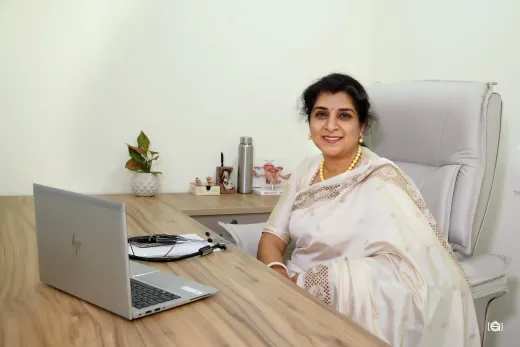
By Dr. Shweta Agarwal, MBBS, DGO Medically reviewed by Dr. Shweta Agarwal, MBBS, DGO · July 2026
Information on this page is educational and does not replace a medical consultation. Outcomes depend on individual clinical factors.
Aansh Hospital & IVF Center is a government-registered Level-2 ART clinic (Reg. No. MH/AC/2024/15441/L2/Chandrapur/132), serving Chandrapur, Nagpur and the wider Vidarbha region. Our government ART registration covers regulated IVF and ICSI performed by our in-house embryology team.
The rule this page follows
A person appears below only if they personally said it — in an interview, a memoir, or their own social media post — and only for the specific thing they said. Reports about someone, without their own words, are not included. Where a public figure has never addressed the subject, we say that rather than guessing.
That rule leaves out some of the biggest names people search for. Those absences are the most useful part of this article.
At a glance: who disclosed what
| Person | What they personally disclosed | Where they said it | What it does not establish |
|---|---|---|---|
| Farah Khan | IVF at 42, delivered triplets at 43 | Shekhar Tonite chat show (report) | Her diagnosis, protocol or clinic |
| Mahhi Vij | Conceived through IVF; an earlier attempt did not succeed; was advised to hide it | Her own interviews (report) | Any medical cause |
| Michelle Obama | A miscarriage; "we had to do IVF for both girls" | Becoming; ABC News / GMA interview | A named diagnosis |
| Jennifer Aniston | Years of unsuccessful IVF | Allure, 2022 | A named diagnosis |
| Amy Schumer | Her own cycle numbers: 35 eggs, 26 fertilised, 1 embryo reported normal on PGT-A, 2 mosaic | Her Instagram (report) | That these numbers are typical |
| Gabrielle Union | Repeated IVF cycles, eight or nine miscarriages, later an adenomyosis diagnosis | We're Going to Need More Wine; ABC News | That adenomyosis caused every loss |
| Hugh Jackman | "We did IVF and Deb had a couple of miscarriages" | Katie Couric's Katie, 2012 (report) | Whose factor, or any cause |
| Chrissy Teigen | Used IVF; chose to transfer a female embryo first | Her own public statements (report) | That this is lawful in India — it is not |
| Tusshar Kapoor | Became a father in 2016 through IVF with surrogacy | DNA India interview and his 2021 book | What Indian law permits today |
| Shilpa Shetty | Pregnancy losses she attributed to "APLA"; her second child born through surrogacy | Her own public statements (report) | That she underwent IVF |
| Mark Zuckerberg | Three miscarriages; "it's a lonely experience" | His own Facebook post, 2015 | That IVF was involved |
Did Deepika Padukone use IVF?
As of 27 July 2026, we could not find any first-person public statement from Deepika Padukone saying she used IVF or any fertility treatment. She has spoken publicly about having a physically difficult pregnancy and delivery. She has not spoken about how she conceived.
Absence of a statement is not proof of anything either way — which is exactly the point. It is not known, and it is not ours or anyone else's to fill in.
Why did Deepika Padukone do IVF?
This phrasing assumes something that has not been established. There is no verified "why", because there is no verified "whether". Pages that answer it with a reason, or with a number of cycles, are supplying detail that the person concerned has not made public.
If the reason you searched is that you have a condition you are worried about, the useful reading is about the condition itself — not about who else may or may not have had it. Start with fertility testing for couples.
deepika padukone ivf journey in hindi
दीपिका पादुकोण ने सार्वजनिक रूप से यह कभी नहीं कहा कि उन्होंने IVF या कोई प्रजनन उपचार कराया है। इसलिए उनकी किसी "IVF journey" की पुष्टि नहीं की जा सकती।
Pages that narrate a protocol, a cycle count or a clinic for her are describing something that has never been publicly confirmed. What is genuinely worth knowing — what an IVF cycle involves, what it costs, and what your own chances are at your own age — is on our IVF treatment page and our IVF cost and EMI page. A full Hindi version of this article is at /hi/blog/celebrities-who-spoke-about-ivf/.
Did Aishwarya Rai have IVF?
As of 27 July 2026, we could not find any first-person public statement from Aishwarya Rai Bachchan on this subject. The claim circulates as an inference drawn from her age at the time of her pregnancy.
That inference gets applied to ordinary women too — the assumption that anyone who conceives after 35 must have "had treatment". Many women conceive naturally in their late thirties; many women in their twenties need IVF. Age shifts probability, not certainty, as our page on IVF success and age sets out.
Why speculating about anyone's fertility is harmful
In our clinic in Chandrapur, one reason couples repeatedly give for delaying their first visit is the fear that someone will find out. Speculation feeds that directly:
- It teaches people that fertility treatment is a secret worth uncovering. Every "did she or didn't she?" article signals to a patient that the answer would be shameful if it were yes.
- It defaults the attention to women. Almost every celebrity fertility rumour is about a woman — yet about half of couples with infertility have a male-factor component. Nobody speculates about the husband.
- It replaces information with gossip. An evening spent reading about someone else's rumoured cycle count teaches you nothing about your own reports.
If you would not want it asked about you, it is not fair to ask it about someone else.
Verified: public figures who said they used IVF
Farah Khan — "I was 42 when I was trying IVF, 43 when I delivered"
Farah Khan has described conceiving triplets through IVF, in her own words on the chat show Shekhar Tonite: "I was 42 when I was trying IVF, 43 when I delivered." She has also said she was advised, given her age and the risks, to reduce the number of babies she was carrying, and chose not to.
The lesson — age, and why we usually transfer one embryo. Her story is often shared as proof that IVF works at 43. It is more accurately read as proof that it can. Both egg quantity and egg quality decline with age, and the quality decline is the harder one, because it drives both lower success and higher miscarriage risk. The second half of her story matters equally: a triplet pregnancy carries substantially higher risk for the mother and for all three babies. That is why current professional guidance favours transferring a single embryo in most situations, with the number individualised to age, embryo quality and previous history rather than raised to improve the odds. See single vs double embryo transfer.
Mahhi Vij — "people told me not to tell anyone"
Mahhi Vij has spoken in her own interviews about conceiving through IVF and about being told by people around her to keep it hidden. She has said she chose to speak precisely because she is a public figure. She has also described an earlier IVF attempt, in her early thirties, that did not succeed.
The lesson — a cycle that does not work is not a verdict. A first cycle that fails is a common outcome, not an ending. It also generates information — how the ovaries responded, how many eggs matured, how the embryos developed — that a good team uses when planning what to change next. That does not guarantee a better result second time, but it does mean the second attempt is designed rather than repeated. We have written separately on coming to terms after a failed IVF cycle and how multi-cycle IVF costs work, because planning for more than one attempt from the outset is realistic, not pessimistic.
Gabrielle Union — being told "you waited too long"
In her memoir We're Going to Need More Wine, Gabrielle Union wrote about eight or nine miscarriages and repeated IVF cycles. Speaking publicly afterwards about her eventual adenomyosis diagnosis, she described what came before it: "everyone had just sort of chalked it up to 'You're a career woman, you've prioritised your career, you waited too long and now you're just too old to have a kid.'"
The lesson — age is a factor, not a substitute for assessment. Adenomyosis — endometrial-type tissue within the muscular wall of the uterus — can often be suspected on ultrasound or MRI when specifically looked for, though it is not always straightforward to identify and is sometimes missed. Age genuinely does affect fertility. But when age is offered instead of an evaluation of both partners, a treatable finding can go unnamed for years. If nobody has assessed your uterus and ovaries and tested your partner, the age explanation has not yet been tested against anything.
Michelle Obama — "the biological clock is real"
In Becoming and in her interview with Robin Roberts on Good Morning America, Michelle Obama disclosed a miscarriage and said of her daughters: "We had to do IVF for both girls." She described realising at 34 and 35 that "the biological clock is real" and that "egg production is limited", and framed speaking as deliberate: "I felt lost and alone, and I felt like I failed. I didn't know how common miscarriages were, because we don't talk about them."
The lesson — reserve can be estimated, within limits. AMH and antral follicle count give a reasonable estimate of ovarian reserve — that is, how many eggs are likely to respond to stimulation. They do not measure egg quality, do not predict natural conception, and do not tell any individual woman how long she has. Read alongside age and history, they are still one of the more useful pieces of early information; see AMH levels by age.
Jennifer Aniston — "I would've given anything if someone had said, freeze your eggs"
In her 2022 Allure interview, Jennifer Aniston spoke publicly for the first time about years of unsuccessful IVF: "I was going through IVF, drinking Chinese teas, you name it. I was throwing everything at it." On what nobody told her: "I would've given anything if someone had said to me, 'Freeze your eggs. Do yourself a favour.'"
The lesson — the gap was information, not technology. Fertility preservation, including egg freezing, is available in Chandrapur and appears in our published cost bands. Whether it is appropriate for you depends on your age, your reserve and your plans — and egg freezing has its own limits and no guarantee of a future baby, which is part of the conversation rather than a footnote to it.
Amy Schumer — 35 eggs, one embryo reported normal
Amy Schumer posted her own cycle outcome to Instagram: 35 eggs retrieved, 26 fertilised, and from those, one embryo reported as chromosomally normal on PGT-A plus two low-level mosaic embryos.
The lesson — retrieved eggs are not embryos. These are her reported numbers for one cycle, not a benchmark: the drop-off varies substantially with age, egg maturity, sperm factors, embryo development, laboratory conditions and transfer strategy. What her figures illustrate is the shape of the funnel, which surprises almost every patient. Retrieved eggs are not all mature; mature eggs do not all fertilise; fertilised eggs do not all reach blastocyst; and PGT-A reports a probability from a small biopsy rather than a definitive diagnosis of the whole embryo — mosaic results in particular need specialist counselling before any decision. We explain the sequence in our first IVF cycle week-by-week timeline and in who needs PGT-A.
Hugh Jackman — a man saying it in his own words
On Katie Couric's show Katie in 2012, Hugh Jackman said plainly: "We did IVF and Deb had a couple of miscarriages." Speaking about the silence around it: "It's almost secretive. But it's a good thing to talk about. It's more common and it's tough, there's a grieving process you have to go through."
Note what he did not disclose: a cause. That is entirely his right — and it is also the pattern. Detailed first-person disclosures from women are easy to find; from men they are rare, and where male infertility is reported about a famous man it is usually second-hand rather than his own words. We left those names out for that reason.
The lesson — both partners, together, from the start. About half of couples with infertility have a male-factor component, and it is not detectable without a semen analysis. Professional guidance is that both partners are assessed concurrently, with semen analysis part of the initial male evaluation — not held back until the female workup is exhausted. Both partners are evaluated together at Aansh from the first visit. See male fertility myths vs facts and what your semen analysis numbers mean.
Chrissy Teigen — legal there, criminal here
Chrissy Teigen has spoken openly about her IVF, including saying that she and her husband chose to transfer a female embryo first.
The lesson — sex selection is a criminal offence in India. Selecting the sex of an embryo or foetus for non-medical reasons is prohibited under the Pre-Conception and Pre-Natal Diagnostic Techniques (PCPNDT) Act, 1994, and under the ART (Regulation) Act, 2021, with liability for the clinic and for the person seeking it. No registered ART centre in India can offer it, ours included. The only narrow statutory exception concerns identifying sex where it is necessary to diagnose, prevent or treat a sex-linked disorder. Embryo genetic testing (PGT) is permitted in India on medical indication — for known, pre-existing, heritable or genetic disease — never for choosing a boy or a girl. If you arrived here from a search about choosing a baby's sex through "test tube baby" treatment, that is the whole answer.
Tusshar Kapoor — and a law that has since changed
Tusshar Kapoor has spoken in interviews, and written a book, about becoming a single father in 2016 through IVF with surrogacy.
The lesson — treat pre-2021 arrangements as history, not as a template. The Surrogacy (Regulation) Act, 2021 and the ART (Regulation) Act, 2021 changed both who may access surrogacy in India and how ART clinics and banks are regulated; commercial surrogacy is prohibited and eligibility is now narrowly defined, and the rules have been amended since. An arrangement reported from before 2021 tells you nothing reliable about what is permitted now. If surrogacy or donor gametes are part of your question, current eligibility should be checked first — we will go through the current position with you at consultation, and we hold ART Bank registration for lawful donor gamete handling.
Disclosed pregnancy loss or surrogacy — but not IVF
Two frequently listed names belong in a separate category, because what they described is not IVF.
Shilpa Shetty has publicly described pregnancy losses that she attributed to "APLA", and that her second child was born through surrogacy. She did not describe undergoing IVF herself.
The lesson — recurrent pregnancy loss deserves an investigation of its own. Recurrent pregnancy loss and secondary infertility — difficulty conceiving after a previous pregnancy — are different problems, and both are under-investigated because families assume "it worked before, so nothing is wrong." Antiphospholipid syndrome is one recognised and manageable cause of recurrent pregnancy loss, but it is a clinical diagnosis: it requires defined clinical criteria plus qualifying antibody results confirmed on repeat testing weeks apart — not a single blood test. In many couples, a full workup finds no cause at all, and that is a recognised outcome rather than a failure of testing. Guidance generally supports evaluation after two or more losses; see what tests are done after recurrent miscarriage.
Mark Zuckerberg disclosed, in a 2015 post on his own Facebook page, that he and his wife had three miscarriages: "It's a lonely experience." He did not mention IVF. The disclosure is still worth naming, because it is one of very few from a man about pregnancy loss.
Which celebrity is a test tube baby?
In reviewing first-person and parental disclosures, we could not verify any film, music or sports celebrity who has been confirmed as conceived through IVF by themselves or their parents. The claims you will find attached to particular singers and actors online do not come from the people concerned. It is worth separating two different questions here: a celebrity who used IVF (several, listed above) and a public figure born through IVF (a much shorter, historical list).
The genuinely famous person in the second category is famous for it. Louise Brown was born in the United Kingdom on 25 July 1978, the first human conceived through IVF. She grew up, married, and had her own children conceived naturally.
India's history follows closely. Kanupriya Agarwal, called "Durga", was born in Kolkata on 3 October 1978, from work by Dr Subhash Mukhopadhyay — recognised only long after his lifetime, and still the subject of historical debate about documentation. Harsha Chawda, born in Mumbai on 6 August 1986 under Dr Indira Hinduja at KEM Hospital, is generally described as India's first scientifically documented IVF birth. She, too, later had a naturally conceived child of her own.
The European Society of Human Reproduction and Embryology has estimated that more than 12 million babies have been born worldwide through assisted reproduction since 1978. Statistically, you already know some of them without knowing it. That is the real answer to the question.
What famous people are IVF babies — and does it matter?
Mostly it matters in one direction: it answers the worry underneath the question, which is whether IVF children turn out differently. The reassurance available is genuine but should be stated accurately. Nearly five decades of follow-up now exist, beginning with Louise Brown's generation, who are middle-aged and parents themselves, and the large majority of children conceived through ART are healthy. Some perinatal associations — such as higher rates of preterm birth and low birth weight, driven substantially by multiple pregnancy — are recognised in the literature, and long-term data continue to accumulate. Those are things your doctor should discuss with you honestly, not things to be settled by a celebrity's name.
Talk to us before you talk to the internet
If you searched a celebrity's name tonight, the real question underneath was probably one of these: Am I too old? Is one failed cycle the end? Is it my fault? Will people find out?
Those questions have answers, and the answers are specific to your reports rather than to anyone else's. Dr. Shweta Agarwal offers a free second opinion at Aansh Hospital & IVF Center in Chandrapur, including for couples already under treatment elsewhere. Bring whatever you have — an AMH report, a semen analysis, a previous cycle summary, or nothing at all.
WhatsApp or call +91 80056 85160, or request a free second opinion. Your consultation and records are handled confidentially, in line with medical confidentiality and our privacy policy.
Every disclosure on this page is linked to the individual's own published interview, memoir or post in the table above. Where no first-person statement could be found, we have said so rather than filling the gap.