









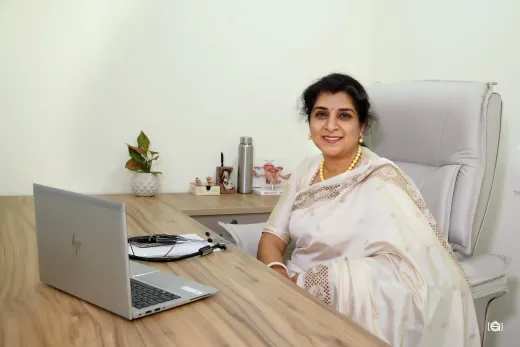
Medically reviewed by Dr. Shweta Agarwal, MBBS, DGO. Last updated: July 2026.
Information on this page is educational and does not replace a medical consultation. Outcomes depend on individual clinical factors.
What is endometriosis? (एंडोमेट्रिओसिस म्हणजे काय?)
Endometriosis is characterised by endometrium-like tissue growing outside the uterus, usually with an inflammatory process that can lead to scarring and adhesions over time. It affects roughly 10% of reproductive-age women worldwide — about 190 million people — according to the World Health Organization; this is a global estimate, not a Chandrapur or India-specific figure. In Marathi and Hindi the loanword एंडोमेट्रिओसिस is commonly used. (Sources: ESHRE Endometriosis Guideline 2022; WHO Endometriosis Fact Sheet, 2025.)
A chocolate cyst (ovarian endometrioma) is one ovarian manifestation of endometriosis — a cyst filled with old blood — and is not the same as the whole disease. Adenomyosis, where similar tissue grows within the muscle of the uterus, is a distinct condition that can coexist with endometriosis; see adenomyosis versus endometriosis. Endometriosis can have significant physical, sexual, emotional, work and study effects, and may need long-term support. (Source: NICE NG73.)
What are the symptoms of endometriosis?
Symptoms that should prompt evaluation include period pain that disrupts daily activities, chronic pelvic pain, deep pain during or after intercourse, cyclical painful bowel movements or pain when passing urine, and difficulty conceiving alongside any of these. Fatigue can also occur. Importantly, symptoms alone cannot confirm the diagnosis, and disease severity does not reliably match pain intensity. (Source: NICE NG73, recommendations 1.3.1 and 1.6.1.)
Common patterns include:
- Painful periods (dysmenorrhoea) that interfere with work, school or sleep.
- Chronic pelvic pain that can persist outside menstruation.
- Deep pain during or after sex (dyspareunia).
- Cyclical bowel or bladder symptoms — painful bowel movements or pain passing urine around periods.
- Difficulty conceiving, sometimes the first sign found during a fertility check.
एंडोमेट्रिओसिसची शक्यता कधी तपासावी? पाळीत असह्य वेदना · संभोगाच्या वेळी किंवा नंतर खोलवर वेदना · पाळीत शौच किंवा लघवी करताना वेदना · ओटीपोटात सतत दुखणे · गर्भधारणा होण्यात अडचण. दैनंदिन काम, शाळा/कॉलेज किंवा नोकरी थांबवावी लागेल इतकी पाळीची वेदना सामान्य समजून दुर्लक्ष करू नका. See also painful periods and other menstrual problems (पाळीच्या समस्या).
How is endometriosis diagnosed?
Diagnosis usually begins with a detailed history and, with your consent, an examination — it does not require surgery in every case. A normal examination or a normal scan does not rule out endometriosis, particularly superficial disease, so persistent life-impacting symptoms still merit gynaecology assessment. Care and choices are explained, and internal examination or scans are done only when clinically appropriate and with your consent. (Source: NICE NG73, recommendations 1.3.5–1.5.5.)
History and examination
Dr. Shweta Agarwal reviews your pain, menstrual, sexual, bowel/bladder and fertility history. This can be a sensitive conversation, and a lady gynaecologist consultation in your own language is often more comfortable for discussing painful sex or internal examination.
Ultrasound
Transvaginal ultrasound is recommended for suspected endometriosis, even when examination is normal, to look for endometriomas and deep disease and to help guide referral. A transabdominal pelvic scan is an alternative if transvaginal ultrasound is declined or unsuitable — for example for some adolescents. Sex determination is illegal and is not performed here. (Source: NICE NG73, recommendations 1.5.2–1.5.5.)
MRI (selected cases)
Pelvic MRI or specialist ultrasound can map suspected deep endometriosis involving the bowel, bladder or ureters, and should be interpreted by someone with gynaecological imaging expertise. (Source: NICE NG73, recommendations 1.5.9–1.5.10.)
Laparoscopy — considered selectively
Laparoscopy is not a mandatory or automatic first test. ESHRE regards imaging plus, where appropriate, a trial of hormonal treatment, and diagnostic laparoscopy as reasonable pathways, with no proven superiority — the pros and cons are discussed with you. Laparoscopy may be considered when imaging is negative but suspicion remains, when symptoms persist despite treatment, or when its findings would change management. A negative biopsy does not entirely rule out disease. Serum CA-125 is not used to diagnose endometriosis. (Sources: ESHRE 2022, recommendations 6–7; NICE NG73, recommendations 1.5.8–1.5.15; ACOG Clinical Practice Guideline 11, 2026.) International evidence suggests diagnosis can take on average around 4–11 years from symptom onset (ACOG, 2026) — a global figure, not a measured local delay — which is why we do not treat surgery as a prerequisite before care can begin.
Care options: medical management versus laparoscopy
Endometriosis care is individualised around your symptoms, fertility goals, age, ovarian reserve, disease location, previous treatment and preferences — not disease stage alone. When pregnancy is not the immediate goal, a short trial of simple pain relief and hormonal options can reduce pain; laparoscopy is considered for selected patients. There is no single "best" path for everyone, and no treatment can promise a permanent cure. (Sources: NICE NG73 sections 1.4, 1.9–1.10; ESHRE 2022, recommendation 37.)
| Consideration | Medical management | Laparoscopic management |
|---|---|---|
| Main role | Reduce endometriosis-associated pain when pregnancy is not being attempted now | Diagnose/treat selected disease, address pain or anatomy, treat selected infertility cases |
| Typical options | Short trial of paracetamol/NSAID; hormonal options (e.g. combined hormonal contraceptives, progestogens) after individual assessment | Excision or ablation of lesions, adhesiolysis, or selected endometrioma surgery, with informed consent |
| Fertility implication | Hormonal suppression prevents conception while used; not prescribed to improve spontaneous pregnancy rates | Possible fertility benefit depends on context; ovarian surgery can reduce ovarian reserve |
| Key caution | Do not self-start hormones; medicines manage symptoms, they do not cure the disease | Surgery is not needed by everyone and does not guarantee pain relief or pregnancy |
(Comparison sources: NICE NG73 sections 1.4, 1.9, 1.10; ESHRE 2022, recommendations 10–37.)
Medication classes are mentioned here for education only; the right choice is made after individual assessment. There is no guideline-supported evidence that a specific diet, supplement, yoga or exercise programme treats endometriosis or improves pregnancy chances, though general wellbeing support may be discussed. (Source: ESHRE 2022, recommendation 38; NICE NG73, recommendation 1.8.1.) Endometriosis is chronic and can recur after treatment; hysterectomy is reserved for selected patients who no longer wish to conceive and have not responded to conservative options, and does not necessarily resolve symptoms. For procedure detail, preparation, risks and recovery, see laparoscopy for endometriosis.
Endometriosis and fertility
Endometriosis can be associated with infertility through altered pelvic anatomy and adhesions, tubal dysfunction, inflammation and ovarian endometriomas — but it does not make infertility inevitable, and many affected women conceive. A fertility plan considers age, how long you have been trying, tubal function, ovarian reserve, semen analysis, pain and previous surgery — not stage alone. (Sources: WHO 2025; ESHRE 2022, Chapter III and recommendations 46–49; NICE NG73 section 1.10.)
- IUI with ovarian stimulation may be considered in stage I/II disease; its value in more advanced disease is uncertain. It is not universally first-line. See IUI for selected endometriosis-related infertility.
- IVF/ART may be appropriate when tubal function is affected, there is a male factor, or other treatment has failed. No specific stimulation protocol can be recommended specifically for endometriosis, and IVF should not be described as bypassing all effects of the disease. See IVF when endometriosis affects fertility.
- Surgery before IVF is not recommended routinely just to improve live-birth rates; endometrioma surgery shows no live-birth benefit and is likely to reduce ovarian reserve. It may still be considered for pain or follicle access. (Source: ESHRE 2022, recommendations 55–58.)
- Before any endometrioma surgery, AMH/antral follicle count, whether disease is one- or two-sided, pain and fertility plans are discussed. AMH estimates egg quantity/response, not egg quality or a natural-pregnancy guarantee. Pregnancy is not a treatment for endometriosis. (Source: ESHRE 2022, recommendations 56, 59–60.)
A fertility assessment (fertility diagnostics) helps build an individual plan. For how doctors weigh options, see surgery versus IVF for blocked tubes and endometriosis.
When to seek urgent care
Seek prompt medical assessment for sudden severe pelvic pain, fainting or dizziness, heavy bleeding, fever with vomiting, or one-sided pain with a possible pregnancy. These can have causes other than endometriosis and need timely evaluation.
Care at Aansh, Chandrapur
Dr. Shweta Agarwal, MBBS, DGO, is a female/lady gynaecologist consulting in Chandrapur at Aansh Hospital & IVF Center, a government-registered Level-2 ART clinic. Consultations are available in Marathi, Hindi and English, and internal examination or scans are explained and consent-led. The focus is timely evaluation and individualised care rather than any promised outcome. See our gynaecology care in Chandrapur and clinic registrations and certificates.
References
- World Health Organization. Endometriosis fact sheet, 2025.
- ESHRE. Endometriosis Guideline, 2022.
- NICE. Endometriosis: diagnosis and management (NG73), updated 2024.
- ACOG. Clinical Practice Guideline 11 (news summary), 2026.