









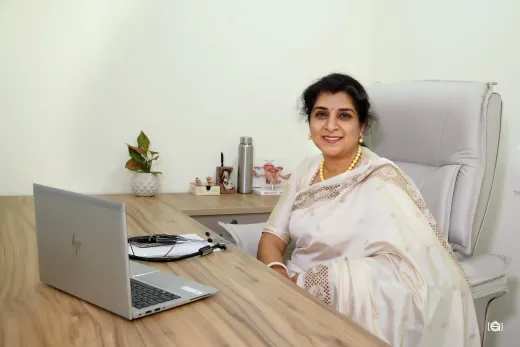
By Dr. Shweta Agarwal, MBBS, DGO Medically reviewed by Dr. Shweta Agarwal, MBBS, DGO Last updated: July 2026
Information on this page is educational and does not replace a medical consultation. Outcomes depend on individual clinical factors.
Aansh Hospital & IVF Center is a government-registered Level-2 ART clinic (Reg. No. MH/AC/2024/15441/L2/Chandrapur/132), part of a growing network of fertility centres across Vidarbha and northern Telangana — but unlike a chain, where each centre's doctors work independently, Dr. Shweta Agarwal holds final treatment authority for every cycle we run, at every location. Our headquarters and in-house embryology lab are in Chandrapur. Our ART registration can be verified at the National ART & Surrogacy Registry (registry.artsurrogacy.gov.in). This page does not walk through the IVF process step by step — the IVF treatment page does that thoroughly — and it does not teach the visit schedule; the Chandrapur IVF logistics guide does that. What this page addresses is the geographic decision: what practically changes when you do a full IVF cycle locally versus travelling 130 km to Nagpur for each appointment.
"Nagpur madhe jaave ka Chandrapur madhe?" — this is a question couples from across Vidarbha and northern Telangana ask us regularly. The answer depends on several factors beyond simple distance, and I want to give you an honest picture of all of them.
What is the real travel burden of a metro IVF cycle?
An IVF cycle is managed in real time across several weeks, so it needs a series of appointments — most of them short scans, a few of them time-critical and scheduled at short notice — and the Chandrapur IVF logistics guide sets out exactly how many, in what order, and which ones need an overnight stay. For this decision, the only figure that matters is that the number is never one.
Chandrapur to Nagpur is approximately 130 km, typically 2.5–3 hours by road. A monitoring scan is usually done in the morning; results and medication adjustments come later the same day. For a couple travelling from Chandrapur, a single monitoring visit involves:
- Early departure from Chandrapur to reach Nagpur in time for a morning scan
- Waiting for results and possibly a follow-up call with dose changes
- Return journey in the afternoon or evening
Because monitoring falls every second or third day through stimulation, roughly every other day becomes a travel day — and retrieval day (early morning, sedation, recovery, cannot drive back) forces an overnight on top. Across a full cycle that adds up to seven or more Nagpur travel days.
Put a rupee figure on it before you decide. Return road travel over that many days, an overnight around retrieval, food, and — the cost most couples underestimate — days of lost earnings for both partners, since these are workdays, not weekends. For a self-employed or daily-wage household that lost income can rival a meaningful share of the treatment bill itself. For couples from Yavatmal, Wardha, or Gadchiroli who are already at a greater distance, the burden is proportionally higher, and the same arithmetic argues for the nearest capable centre rather than the largest one.
This is not an argument that metro clinics are wrong to attend. For specific advanced sub-services — certain genetic testing platforms, highly specialised male-factor interventions, or sub-subspecialty second opinions — referral to a larger metropolitan centre may occasionally be appropriate. The question is whether the routine IVF cycle, including its monitoring and embryology, needs to be managed at that distance.
What does "in-house embryology lab" mean for local care?
The IVF embryology lab is where fertilisation, embryo culture, and grading happen. When a clinic's lab is on-site — in the same building as the consultation and procedure rooms — your eggs and embryos never leave that controlled environment from retrieval to transfer. Environmental parameters (temperature, pH, air quality, CO₂) are maintained continuously by the same team.
When a clinic does not have a full on-site lab, eggs or embryos may be transported to a partner lab in another location, or the clinic may be a satellite consultation centre that refers the procedure itself elsewhere. This introduces transport risk and breaks the chain of custody.
Aansh's embryology lab is on-site in Chandrapur, led by Aayush Agarwal, Ph.D., our senior clinical embryologist. Every step of an IVF cycle — retrieval, fertilisation, culture, grading, and transfer — is performed in that lab. For more on why on-site embryology matters in detail, see Is the IVF lab on-site — and why it matters.
What to ask any clinic, whether in Chandrapur or Nagpur: "Is your embryology lab physically in this building? Who is the named embryologist, and are they present for every cycle?"
What about doctor continuity across a full cycle?
An IVF cycle works best when the same senior doctor sees your scans, adjusts your protocol, and performs your egg retrieval and transfer. That continuity means the person who retrieves your eggs already knows how your ovaries responded to stimulation, what the follicle sizes and estradiol trajectory looked like, and what your specific situation warrants at each step.
In a large-volume chain clinic, continuity is not guaranteed. Depending on scheduling and on-call rotas, the doctor who does your retrieval may not be the same doctor who did your monitoring scans or who will do your transfer. This is not inherently wrong — well-run teams with good handover protocols manage this — but it is a real variable worth asking about.
At Aansh, Dr. Shweta Agarwal leads consultations, monitoring, retrieval, and transfer across the cycle. The embryology is led by Aayush Agarwal, Ph.D.. Couples from Chandrapur, Yavatmal, Wardha, Gadchiroli, and Adilabad/Asifabad regularly access care here without needing to travel to Nagpur.
Comparison: local Chandrapur IVF vs travelling to a Nagpur clinic
| Factor | Local IVF (Chandrapur, Aansh) | Travelling to Nagpur |
|---|---|---|
| Monitoring visits | Walk-in/short drive from Chandrapur | ~130 km each way, 2.5–3 hrs, multiple times |
| Travel burden per cycle | Minimal; same city | 7+ Nagpur travel days across 4–6 weeks |
| Lab location | On-site in Chandrapur (embryos never leave) | Depends on clinic — ask specifically |
| Doctor continuity | Dr. Shweta Agarwal across full cycle | Depends on clinic's rota — ask specifically |
| Embryologist continuity | Aayush Agarwal, Ph.D. on-site | Depends on clinic's staffing — ask specifically |
| ART registration to verify | MH/AC/2024/15441/L2/Chandrapur/132 | Verify the Nagpur clinic's own ART reg. number |
| Advanced sub-services | Full in-house IVF, ICSI, PGT, blastocyst culture | Larger chain may offer niche sub-specialties — verify |
| Cost transparency | Written estimate before any procedure | Ask for written, itemised estimate upfront |
| Language | Marathi, Hindi, English | Varies by clinic |
What should you verify at any clinic — local or metro?
The checklist does not change with the distance: current ART Level-2 registration — verifiable by number on the National ART & Surrogacy Registry at registry.artsurrogacy.gov.in — an embryology lab physically at the clinic's own address, a named embryologist present for your cycle, one senior doctor across monitoring, retrieval, and transfer, a written itemised estimate before anything is prescribed, and a team that can explain all of it in Marathi or Hindi.
We have set out how to run those checks, question by question, in what ART Level-2 registration means and how to verify any clinic. Apply it to us as readily as to a Nagpur clinic: our own registration is on the ART registration page, and our costs and EMI page shows the estimate format you should expect anywhere.
If you have already had an infertility workup elsewhere and want an independent read on whether the recommended treatment plan is appropriate before choosing a clinic, our free second opinion is available by WhatsApp or in person.
Is there any reason to go to Nagpur rather than local?
Yes — and being honest about this matters. Larger metropolitan centres may appropriately be the right choice when:
- A highly specific sub-specialist is needed (for instance, a urologist for complex surgical sperm retrieval, or a geneticist for PGT interpretation in rare syndromes)
- A second specialist opinion is sought from a different team independently
- A patient has a medical complexity that warrants a multi-speciality hospital environment alongside the IVF cycle
What these situations have in common is that they are exceptions for specific clinical reasons — not the default for a routine IVF cycle. For the large majority of couples undergoing IVF in Chandrapur, Wardha, Yavatmal, or the surrounding Vidarbha catchment, the clinical requirements of the cycle do not mandate metro travel.
The decision should be made on verified clinical grounds, not on brand recognition or the assumption that distance equals quality.