









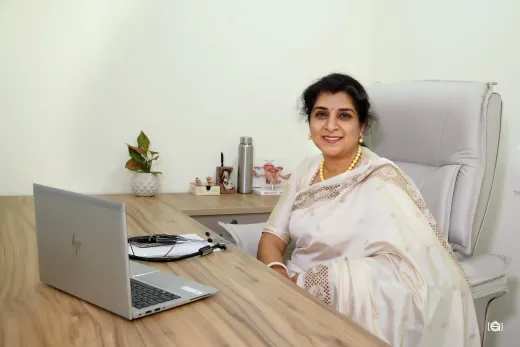
By Dr. Shweta Agarwal, MBBS, DGO Medically reviewed by Dr. Shweta Agarwal, MBBS, DGO Last updated: July 2026
Information on this page is educational and does not replace a medical consultation. Your exact medication plan, doses, and injection schedule depend on individual clinical factors and are decided by your treating doctor.
Aansh Hospital & IVF Center is a government-registered Level-2 ART clinic (Reg. No. MH/AC/2024/15441/L2/Chandrapur/132), part of a growing network of fertility centers across Vidarbha and northern Telangana — but unlike a chain, where each centre's doctors decide independently, Dr. Shweta Agarwal holds final treatment authority for every cycle, at every location. Our headquarters and in-house embryology lab are in Chandrapur. Our government ART registration covers IVF, ICSI, and embryo transfer — all performed on-site under the clinical leadership of Dr. Shweta Agarwal and embryology led by Aayush Agarwal, Ph.D..
When patients sit across from us at the first IVF counselling session, the questions are rarely about embryology. They are about the injections. Kitne injections lagenge? Kahan lagte hain? Dard kitna hota hai? Ghar par laga sakte hain kya? The fear of a fortnight of daily needles stops some couples from even starting — which is a pity, because for most patients the injections turn out to be the easiest part of the cycle, far easier than the anxiety beforehand.
This guide answers those questions the way we answer them in the clinic: plainly, day by day, with no numbers invented to sound impressive. It pairs with our week-by-week IVF cycle timeline, which covers the whole journey; here we zoom in on the injection phase only.
IVF injection kaha lagta hai? (Where are IVF injections given?)
This is the question we are asked most often — injection kahan lagta hai, kahan lagaya jata hai? — and the answer is simpler than most people expect. Almost all IVF injections go into one of two places:
1. Under the skin of the lower belly (subcutaneous). This is where the daily stimulation injections go — into the layer of fat a few centimetres to the side of the navel, at the exact spot and angle your nurse teaches you (each medicine's leaflet specifies its own site details, which is why the teaching session matters). The needle is short and very fine, similar to an insulin needle. The thigh (front-outer part) is an equally acceptable site for many of these medicines; the IVF patient guidance from Guy's and St Thomas' NHS Foundation Trust describes the daily FSH injections as given "just under the skin on the thigh or tummy." You pinch a fold of skin, insert the needle as taught, press the plunger, and it is done in seconds.
2. Into the muscle of the upper-outer buttock (intramuscular). A few injections — in some protocols the trigger shot, and in some protocols progesterone support — go deeper, into muscle, with a longer needle. These are the ones people describe as "the painful ones," and we cover them honestly below.
Nothing is injected into the uterus, the ovaries, or anywhere near the vagina during the stimulation phase. That is a common fear and it is unfounded — the medicines travel through your bloodstream to the ovaries.
| Injection type | Where it goes (kaha lagta hai) | Needle | Who usually gives it |
|---|---|---|---|
| Daily stimulation (FSH / hMG) | Fat under skin of lower belly or thigh | Short, very fine | You or a family member, at home |
| Antagonist (prevents early ovulation) | Fat under skin of belly | Short, very fine | You, at home |
| Trigger shot | Belly (subcutaneous) or buttock (intramuscular), protocol-dependent | Fine or longer | You at home, or clinic staff |
| Progesterone support (if injectable) | Upper-outer buttock, into muscle | Longer | Family member or nurse |
Not every patient gets every row of this table — many patients at Aansh use vaginal progesterone pessaries rather than injections for luteal support, which removes the most-feared needle from the list entirely. Your protocol is decided by your doctor, not by a website.
IVF injections how many days? (IVF injections kitne din tak lagte hain?)
The daily-injection phase — ovarian stimulation — typically runs 8 to 14 days. Guy's and St Thomas' NHS Foundation Trust describes 10–14 days of daily FSH injections; the exact end point for any individual patient is not set by the calendar but by follicle scans. Stimulation continues until your lead follicles reach the size your doctor wants, then it stops and the trigger shot is given.
Two things patients often misunderstand here:
- The number of days is not a report card. Needing 13 days instead of 9 does not mean your cycle is going badly; it means your ovaries respond at their own pace, which is exactly what the monitoring scans are for.
- Injections do not continue for the whole IVF cycle. After egg retrieval there are no more daily stimulation injections. If your luteal support is vaginal or oral, your needle days are already over at that point.
How many injections for IVF treatment in total? (IVF mein total kitne injections lagte hain?)
If you search this, you will find websites claiming anywhere from around ten to over a hundred — because different clinics count different things (some count only stimulation shots; others count every needle including blood draws). The honest answer: there is no universal number, but you can see exactly where your own number will come from. In an antagonist protocol, the arithmetic is simple:
| Phase | What is injected | How often |
|---|---|---|
| Stimulation | FSH, sometimes with hMG | Usually once daily, for the 8–14 stimulation days |
| Ovulation prevention | Antagonist injection | Once daily, added partway through stimulation once scans show it is needed |
| Trigger | hCG or agonist trigger | Once, at an exact clock time set by the clinic |
| Luteal support | Injectable progesterone — only in some protocols | Many patients instead use vaginal pessaries: zero needles in this phase |
Multiply your stimulation days by your daily doses, add the antagonist days and the single trigger, and you have your personal total — for most antagonist-protocol patients with vaginal progesterone it works out to a few dozen small injections spread over roughly two weeks. When a website claims one universal number, it is simplifying. Ask your doctor for your expected schedule in writing — at Aansh it goes on your schedule card on day one.
What is the most painful IVF injection?
There is no single injection that is "the most painful" for everyone — but the patterns patients report are consistent enough to be honest about:
- The daily subcutaneous stimulation injections are usually the gentlest. With fine needles and pen devices, most patients describe them as a brief pinch, and commonly say the fear before the first injection was worse than the injection itself.
- Some stimulation medicines sting more than others. Menotropin (hMG) preparations are commonly reported to sting or burn briefly as the medicine goes in — the needle is not the problem, the solution is.
- Intramuscular injections are generally more uncomfortable than subcutaneous ones. The needle is longer and goes into muscle; soreness at the site the next day is common.
- Progesterone in oil, given intramuscularly, is the injection most often described by patients as the most painful — the oil-based liquid is thick and repeated daily doses can leave the area sore and lumpy. Importantly, many protocols never use it: where clinically appropriate, vaginal progesterone does the same job with zero needles.
Things that often reduce the discomfort — ask your nurse which apply to your specific medicines, since storage and preparation rules differ by product: letting a refrigerated medicine sit briefly before injecting if its leaflet allows, icing the spot beforehand for subcutaneous injections, gentle warmth and massage after intramuscular ones, rotating sites daily, and injecting slowly. If any injection site becomes hot, hard, and increasingly painful, show it to us — do not just push through.
The day-by-day injection diary (an illustrative antagonist-protocol timeline)
This is what the injection phase feels like for a typical patient on an antagonist protocol — the illustration below is a map, not a prescription. Your own start day, doses, scan dates, and injection times come from your written schedule, and they will shift as your scans come in. Note that "Day 2–3" below refers to days of your menstrual cycle, while "stimulation days" count from your first injection.
Cycle Day 1–2 (your period starts): You visit the clinic for a baseline scan and blood test. If all is clear, injections typically start from Day 2 or Day 3 of the cycle. Our nurse teaches you (and whoever will help you at home) how to prepare and give the injection, and supervises your first one. Most patients are surprised: "Bas? Ho gaya?"
Stimulation days 1–4: One subcutaneous injection a day, in the daily time slot fixed on your schedule (evenings suit many working patients). Some days you feel a mild sting from the medicine going in, some days almost nothing. Rotate sides — left of the navel one day, right the next — so no single spot gets sore. Life continues normally: work, cooking, travel.
Mid-stimulation: A scan checks how your follicles are growing, and — at the point your scans indicate, often around stimulation day 5–6 in antagonist protocols — a second small daily injection (the antagonist) is added to prevent your body from ovulating early. Two pinches a day now instead of one. Mild bloating often begins around here as the ovaries grow heavier.
Later stimulation: Scans are repeated at intervals your doctor sets based on how the follicles respond. Doses may be adjusted up or down; this is normal steering, not a problem. Bloating, heaviness low in the belly, tender breasts, and tiredness are commonly reported now. This is also the stretch where the routine starts to feel long — a fixed daily ritual (same room, same time, injection, then something you enjoy) genuinely helps.
Trigger day (whenever scans say the follicles are ready): Daily injections stop. You take one final injection — the trigger — at an exact clock time given by the clinic, because egg retrieval is scheduled a set interval later, typically about 34–36 hours. This is the one injection where timing is not flexible, and we confirm the timing with you on the day.
Retrieval day: No more stimulation injections — from here, injections only continue if your team specifically instructs it. The egg retrieval itself is done under anaesthesia or sedation, so the needle work you were dreading is not something you experience awake and in pain.
After retrieval: Luteal (progesterone) support begins. For many patients this is a vaginal pessary — no needles. If your protocol uses injectable progesterone, this is when the intramuscular injections start, usually given by a family member or a local nurse.
Ask us about the printable day-by-day injection schedule card at your counselling visit — a one-page grid with your dates, drug names, doses, injection sites, and scan appointments that you can stick on the fridge or keep on WhatsApp. It converts a frightening fortnight into a checklist.
Can I take IVF injections at home? (IVF injection at home)
Yes — home administration after supervised teaching is standard practice, and it is how many Aansh patients manage the injection phase. This matters more in Vidarbha than in a metro: many of our patients come from Ballarpur, Bhadravati, Rajura, Gadchiroli, and towns an hour or more from Chandrapur, and travelling to a clinic every single day for one small injection would make IVF impractical. So we design the injection phase around your home:
- Our nursing team teaches you and one family member the full routine — storage, preparation, air-bubble removal, site, angle, disposal — and watches you do the first one yourself.
- Medicines that need refrigeration travel in a small cool pack; at home they live in the fridge (never the freezer).
- You come to Chandrapur only for the monitoring scans, not for the daily injections.
- If nobody at home can give an injection, tell us — a local nurse or our team can help you arrange administration, and we remain one WhatsApp message away for a "did I do this right?" video call.
IVF injections: how many times a day, what time of day, and same time every day?
How many times a day? In a straightforward antagonist protocol it is commonly one injection a day for the first stretch of stimulation, becoming two a day once the antagonist is added partway through. Some protocols use a combined preparation that keeps it at one a day; others — separate FSH and LH products, added medicines, or a dual trigger — can mean more. Your written schedule, not a general rule, tells you your number.
What time of day? Follow the time written on your schedule. Where a specific clock time is not clinically required, what matters is picking a slot and keeping to it rather than the slot itself. Many of our patients choose the evening: it fits around work and travel, and it means a next-morning scan reflects a full day of medication. If a particular injection is prescribed for the morning, take it in the morning — some medicines are more time-sensitive than others, and your prescription reflects that.
Do IVF injections have to be at the same time every day? Keep a consistent daily window, exactly as written on your schedule. If a dose is late or missed, do not skip it, double it, or correct it on your own guess: missed-dose instructions differ by drug, so contact the clinic first and we will tell you what to do. The one injection where the exact clock time genuinely matters is the trigger shot, because retrieval is scheduled a fixed interval after it (typically about 34–36 hours, at the exact time your clinic gives you). If anything goes wrong with the trigger — a missed time, a spilled vial, or any doubt about whether the full dose went in — call +91 80056 85160 straight away rather than waiting until your next appointment, and follow the after-hours instructions on your schedule card.
IVF injection side effects: weight gain, bloating, tiredness
The hormones, not the needles, cause the side effects most patients notice:
- Bloating and a feeling of weight gain. The ovaries enlarge as multiple follicles grow, and hormonal fluid retention adds to it. Clothes may feel tight around the waist as stimulation progresses. In most cycles this is predominantly temporary fluid and ovarian size rather than new body fat, and it typically improves after the cycle — mention persistent or unexplained weight change to your doctor.
- Tiredness. IVF injections can leave you tired — hormone shifts, disturbed sleep, and the mental load all contribute. Plan lighter evenings during the stimulation fortnight.
- Mood swings, headaches, breast tenderness, mild nausea — commonly reported during stimulation and usually manageable; tell us about anything that feels severe or does not settle.
- Local site reactions: small bruises, redness, itching at injection spots. Rotating sites keeps this minor.
Warning signs — act immediately: severe abdominal pain or rapidly increasing distension, vomiting that prevents you from keeping fluids down, rapid weight gain, or a sharp drop in urine output can signal OHSS (ovarian hyperstimulation syndrome). Call +91 80056 85160 without waiting for your next appointment. Severe breathlessness, chest pain, or signs of marked dehydration need emergency assessment — come to the hospital or go to the nearest emergency department at once rather than waiting for a call back.
IVF injection kitne ka lagta hai? (What do the injections cost?)
Two separate things get confused here, so it is worth separating them.
The price of an individual injection varies with the molecule, the dose, the brand and the pharmacy — which is why no honest page can quote you a single per-injection figure, and why two patients on the same protocol can have different medicine bills. The dose you need is a clinical matter (ovarian reserve, age, how you respond), not a choice you make.
What you actually pay at Aansh is simpler: standard-protocol ovarian stimulation medications are included in the quoted IVF cycle cost, which is indicatively ₹1,20,000–₹2,40,000 as of July 2026 depending on your protocol. Medications beyond a standard protocol are billed separately, and your exact figure is confirmed in a written estimate before anything begins. Full inclusions, exclusions and the 0% EMI option are on our IVF cost and 0% EMI page.
One thing worth checking wherever you are treated: ask what happens to your bill if you need a higher dose or more days of stimulation than planned. Medication is the component that varies most between patients, so a package that excludes it can be difficult to compare.
What should I avoid during IVF injections?
Keep it simple: no smoking, no alcohol, no crash diets, no new supplements or painkillers without asking us, and no high-impact or twisting-heavy exercise once the ovaries enlarge (brisk walking is fine). Do not skip doses, do not change timing on your own, and do not compare your dose or day count with another patient's — protocols are individual by design.
Worried about the injection phase? Bring your questions — and your reports, if you have been advised IVF elsewhere — to a free second opinion, and leave with your protocol explained and a written day-by-day injection schedule. Message us on WhatsApp at +91 80056 85160.
Sources
- NHS — Guy's and St Thomas': IVF treatment, Step 1 — medicines to produce eggs — daily FSH injections for 10–14 days, given under the skin of the thigh or tummy.
- NHS — Guy's and St Thomas': IVF treatment, Step 2 — egg collection — the timed interval between the trigger injection and egg collection, and what sedation on the day involves.
- NHS — IVF overview — the stages of an IVF cycle and the warning signs of ovarian hyperstimulation syndrome (OHSS).
- HFEA — IVF options — how natural-cycle and mild-stimulation IVF differ from conventional stimulation.
- ASRM — In vitro fertilisation (IVF) patient journey — commonly reported side effects during stimulation, including fatigue, mood changes, breast tenderness and injection-site reactions.