









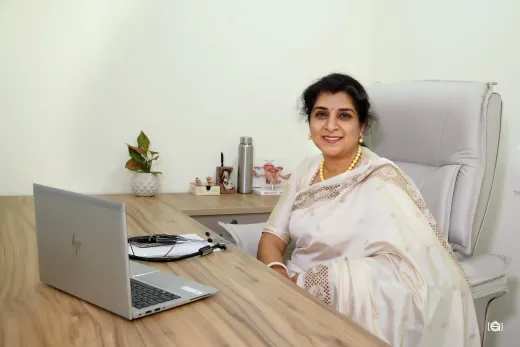
Medically reviewed by Dr. Shweta Agarwal, MBBS, DGO. Last updated: 16 July 2026.
Information on this page is educational and does not replace a medical consultation. Outcomes depend on individual clinical factors.
Parents in Chandrapur rarely search for "adolescent gynaecology" — they search for what they see at home: a daughter whose first period (पहिली पाळी) has not come, periods that skip months (पाळी अनियमित येणे), pain that keeps her home from school (पाळीत खूप दुखणे), or a worrying ultrasound report mentioning "cysts." This page answers those questions the way current guidelines answer them, and explains when a calm gynaecology review in Chandrapur is the right next step.
When should a girl get her first period, and what is normal?
The first period (menarche) usually arrives about 2–3 years after breast development begins. In ACOG's population data the median age was 12.43 years, and 98% of girls had menstruated by age 15 — timing varies by population, so there is no single "correct" age. A first period can be light, brownish, or irregular. [Source: ACOG, "Menstruation in Girls and Adolescents: Using the Menstrual Cycle as a Vital Sign," 2015]
ACOG recommends assessment if there is no breast development by age 13, no first period by age 15, or no period within 3 years of breast development starting. The most useful habit for teens and parents is simple: track the first day of each period, how long it lasts, how heavy it is, and how much it hurts. That record tells the doctor far more than any single test.
Preparing a daughter before menarche — what a period is, which product to use, a small school kit, and whom to tell — reduces fear and shame. Menstruation is a normal body process, not something dirty. [Source: WHO Menstrual Health fact sheet, 2026]
Is it normal for teenagers to have irregular periods?
Yes — often. In the first one to two years after the first period, many cycles are anovulatory, so irregular gaps are common and are frequently part of normal puberty. ACOG describes typical adolescent cycles as 21–45 days, with bleeding lasting 7 days or less. Irregularity alone in the first year is usually not a disease — but red flags still matter at any age. [Source: ACOG, 2015; International Evidence-based PCOS Guideline, 2023]
The 2023 International PCOS Guideline gives time-since-menarche thresholds that are more accurate for teens than adult cycle rules:
| Time since first period | Usually expected / when to book a review |
|---|---|
| First year after menarche | Irregular cycles can be part of normal pubertal transition; red-flag symptoms still need review |
| 1–3 years after menarche | Review cycles shorter than 21 days or longer than 45 days |
| More than 3 years after menarche | Review cycles shorter than 21 days, longer than 35 days, or fewer than 8 cycles a year |
| More than 1 year after menarche | A gap longer than 90 days, even once, needs assessment |
| Any adolescent | No period by 15, or none within 3 years of breast development, needs assessment |
[Source: International Evidence-based Guideline for the Assessment and Management of PCOS, 2023 (Monash University), recommendation 1.1.1]
Missed periods have many possible causes besides PCOS — thyroid disease, high prolactin, low energy intake or eating disorders, intense exercise, chronic illness, and (where relevant) pregnancy. A doctor's job is to sort these out, not to label every missed period as PCOS. In Marathi terms: तीन महिने पाळी न येणे is a reason to consult, not to panic.
Teen period problems: normal variation vs red flags — a parent's table
Most early menstrual variation is normal puberty. Book a gynaecology review when periods have not started by 15, stop for 90 days, sit outside the age-appropriate cycle range, are very heavy (soaking a pad every 1–2 hours or lasting over 7 days), or when pain disrupts school and daily life. [Sources: ACOG, 2015; International PCOS Guideline, 2023]
| What parents see | Often part of normal puberty | Book a review |
|---|---|---|
| Cycle timing | Uneven gaps in the first 1–2 years | Gap over 90 days even once; cycles under 21 or over 45 days after the first year |
| Flow | A light, short, or brownish first period | Soaking a pad/tampon every 1–2 hours; bleeding over 7 days; heavy bleeding from the very first period |
| Pain | Mild cramps managed with heat and rest | Pain that repeatedly stops school, sports, or sleep; vomiting or fainting with periods; pain worsening over time |
| Skin/hair | Mild acne of puberty | Significant excess facial/body hair, severe persistent acne, or rapid weight change alongside irregular cycles |
| No period yet | Younger than 15 with breast development under 3 years | No breast development by 13; no period by 15 |
Seek urgent care now — do not wait for an appointment — if heavy bleeding comes with fainting, severe dizziness, marked weakness, breathlessness, pallor, or a racing heartbeat. Heavy bleeding starting from the very first period can occasionally be the first sign of a bleeding disorder, especially with easy bruising, frequent nosebleeds, or a family history of bleeding. [Source: ACOG, "Screening and Management of Bleeding Disorders in Adolescents With Heavy Menstrual Bleeding," 2019]
How is teen PCOS / PCOD diagnosed — and why an ultrasound is not enough?
In adolescents, PCOS diagnosis requires both persistent irregular cycles (defined by time since menarche, as in the table above) and clinical or biochemical androgen excess — after other causes are excluded. Crucially, ultrasound and AMH blood tests are not recommended for diagnosing PCOS within 8 years of the first period, because "multifollicular" ovaries are common in normal teenage girls. [Source: International Evidence-based PCOS Guideline, 2023, recommendations 1.1.4, 1.4, 1.5]
This matters in practice: a scan report saying "polycystic ovaries" or "cysts" in a 15-year-old is not a PCOS diagnosis. Equally, acne alone is common in puberty and should not be labelled PCOS. If a teen has some features but not the full picture, the guideline supports an "increased risk" label with symptom care and planned reassessment — avoiding both dismissal and overdiagnosis. PCOD is the everyday Indian term; the evidence-based condition name is PCOS, and it is not a separate milder disease — our PCOS page explains the terminology and adult criteria in detail.
Management for teens is symptom- and goal-based: cycle tracking, weight-neutral lifestyle support (sleep, movement, nutrition — without shaming), attention to mood and body image, and clinician-selected medicines where appropriate. It is care and management, not a "cure," and no doctor should promise a permanently "fixed" cycle.
Where pelvic ultrasound is used for any indication, it is purely diagnostic. Sex determination is illegal under the PCPNDT Act and is not performed here.
Period pain in teens: what is normal and what needs assessment?
Mild cramps around periods are common and often respond to local heat, rest, and gentle activity. Pain deserves assessment when it repeatedly causes school absence, brings vomiting or fainting, worsens over time, occurs outside periods, or does not settle with initial clinician-guided care. Disabling pain is not something every girl "must tolerate." [Sources: WHO Menstrual Health fact sheet, 2026; ACOG dysmenorrhoea and endometriosis guidance, 2026]
Primary dysmenorrhoea is period pain without another pelvic disease; secondary dysmenorrhoea can be linked to conditions such as endometriosis. Any medicine — including common painkillers — should be chosen with a clinician or pharmacist for age-appropriate dose and safety; this page deliberately gives no do-it-yourself dosing protocol.
What happens at a teenager's first gynaecology visit?
Usually: a conversation. A first adolescent visit typically covers menstrual history, general health, growth, and the family's concerns — with a general examination where needed. An internal (pelvic) examination or internal scan is not routine at a first teen visit; any examination is symptom-led, explained beforehand, consented, and chaperoned. [Source: ACOG, "Your First Gynecologic Visit" / "The Initial Reproductive Health Visit," 2020]
Work-up, where needed, may include growth/BMI and blood-pressure review, a blood count and iron studies when bleeding is heavy, and targeted hormone tests — decided by symptoms, not a fixed panel for every girl. Teens are addressed directly and respectfully, with parents included supportively; India's RKSK adolescent-health standards emphasise privacy, confidentiality, and non-judgmental care, and the doctor will explain confidentiality along with its safety and legal limits. [Source: National Health Mission, RKSK / Adolescent Friendly Health Centres guidance]
At Aansh Hospital in Chandrapur, consultations are with Dr. Shweta Agarwal, MBBS, DGO — a female gynaecologist — in Marathi, Hindi, or English, which many parents and teenage daughters find easier for these conversations.
Menstrual hygiene for teenage girls
Good menstrual hygiene is about access, comfort, and cleanliness — not one "best" product. A disposable pad, clean reusable pad or cloth, menstrual underwear, tampon, or cup can each be appropriate if used correctly, changed when saturated or uncomfortable, and cleaned or disposed of safely. [Sources: WHO Menstrual Health fact sheet, 2026; Government of India, National Menstrual Hygiene Policy for School-Going Girls, 2024]
Practical points: wash hands before and after changing a product; wash reusable materials as directed and dry them fully in a clean place; use safe disposal. See a doctor — rather than self-treating — for persistent itching, rash, foul-smelling discharge, sores, or fever. India's National Health Mission also runs a Menstrual Hygiene Scheme for rural adolescent girls aged 10–19 through ASHA workers; ask locally about current availability.
HPV vaccination: what age, and why it matters for teens
HPV vaccination is preventive — it helps prevent infection with the HPV types most linked to cervical cancer. The preferred window is girls aged 9–14 years. Per FOGSI-ICOG's 2024 recommendation, ages 9–14 receive two doses at least 6 months apart; from age 15 onward, and for immunocompromised people, a three-dose schedule applies, with product-specific timing confirmed by the treating clinician. [Sources: FOGSI-ICOG GCPR on Prevention and Management of Cervical Cancer, 2024; WHO HPV Vaccine Position Paper, December 2022]
Three honest clarifications: the vaccine does not treat an existing HPV infection; it does not replace cervical screening later in adult life (routine Pap testing is not a teen test); and vaccinating a 9–14-year-old is cancer prevention, not a statement about anyone's behaviour. WHO's vaccine-safety committee and FOGSI have not identified a general safety concern; common reactions are brief local pain, redness, or swelling. Ask the clinic directly about current vaccine availability and schedule for your daughter's age.
Related pages
- Routine and problem-focused gynaecology care in Chandrapur
- Irregular, heavy or absent periods
- PCOS symptoms and assessment
- Endometriosis and persistent period pain
- Cervical cancer prevention and screening
- Women's health in Chandrapur
- Dr. Shweta Agarwal, MBBS, DGO — female gynaecologist
- Book a gynaecology consultation in Chandrapur
References
- ACOG — Menstruation in Girls and Adolescents: Using the Menstrual Cycle as a Vital Sign (2015)
- Monash University — International Evidence-based Guideline for the Assessment and Management of PCOS (2023)
- WHO — Menstrual Health fact sheet (2026)
- Government of India / National Health Mission — National Menstrual Hygiene Policy for School-Going Girls (2024); Menstrual Hygiene Scheme
- FOGSI-ICOG — GCPR: Prevention and Management of Cervical Cancer (2024)
- WHO — Human Papillomavirus Vaccines Position Paper (December 2022)
- ACOG — Screening and Management of Bleeding Disorders in Adolescents With Heavy Menstrual Bleeding (2019)
- ACOG — Your First Gynecologic Visit / The Initial Reproductive Health Visit (2020)
- National Health Mission — RKSK / Adolescent Friendly Health Centres guidance